
The moon landing was both an amazing technological achievement and a stunning propaganda coup. But the moon was both literally and figuratively very far away from the basic concerns of the millions of people across Latin America, Africa and Asia whose governments the United States and western Europe hoped to pull onto their side. What could western science offer all these people? In many cases, these were countries with significant social, economic and political tensions. From the point of view of many people within the American government in the 1950s and 1960s, the question was more cynical: how could the United States intervene to prevent revolutions which might result in left-leaning governments more inclined to seek support from the Soviet Union than the United States? A key way that science could intervene was related to agriculture and food supply — people who had enough to eat were less likely to carry out a revolution. This was the context for the ‘Green Revolution,’ which began with the transfer of agricultural technologies in the 1950s and 1960s and resulted in a surge in agricultural production in poorer parts of the world beginning in the 1960s.
The Green Revolution can be seen in two ways. The first way of seeing it is primarily scientific or technological, and consisted of a toolkit of technologies: high yielding new crop varieties, including hybrids, large amounts of chemical fertilizers, mechanization, and controlled irrigation. The second emphasizes the economic and social effects of these new technologies. In the words of historian Tore C. Olsson,
“Future historians of the twentieth century may well regard the Green Revolution as that era’s most significant phenomenon…With the purported goal of feeding the world, an extensive global network of scientists, politicians, businesses and bureaucrats set in motion two trends that made the twentieth century truly exceptional: the unprecedented growth of global population, and the transition of the human species from being primarily rural in 1900 to being primarily urban by the early twenty-first century. The Green Revolution fueled each transformation, in its vast expansion of grain production and simultaneous uprooting of small-scale cultivators made obsolete by technical change.”

Agricultural science changed the world in the mid-twentieth century. Many of the key tools in the ‘Green Revolution’ tool kit of the 1950s and 1960s were already familiar to American farmers. These included new, high-yielding grain crops which required significant amounts of fertilizer and which had been bred to facilitate mechanical harvesting. The introduction of these technologies in the United States had transformed rural life there in ways that were similar to what happened in South America, Asia and Africa decades later.

As agricultural historian Jack Ralph Kloppenburg, has argued, “the introduction of hybrid corn in the 1930s touched off an American precursor of the Green Revolution.” In other words, the dramatic transformations on Long Island farms in the 1930s, 40s and 50s — hybrid crops, increased yields, more fertilizers, less labor required per acre, the increasing economic pressure to invest in additional parts of the technological system of modern agriculture — these transformations were a local story that foreshadowed the changes that these same American agricultural technologies would bring to the world in the course of the Cold War just a few decades later. Agricultural science on Long Island in the twentieth century was both global and local.
The Green Revolution was very much a Cold War project. It showed the power of American technology and know-how, but in a way designed to win over millions of people in one of the most concrete possible ways: through what they ate. What is the best way to approach this mixture of politics and science? There were many scientists and agricultural reformers during this period who were genuinely and passionately committed to helping feed the world — perhaps the most famous example here is the American agronomist Norman Ernest Borlaug, who was awarded the Nobel Peace Prize in 1970 for the global increase in food production that his work helped bring about. At the same time, Cold War era scientists and policy makers sometimes dismissed or failed to see important social and environmental problems brought about by Green Revolution agriculture. One example of this is nitrogen pollution from ever more intensive use of artificial fertilizers.

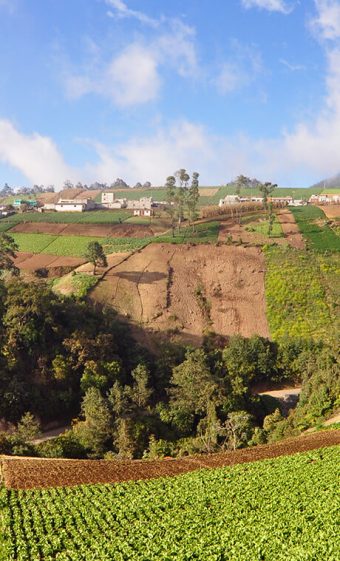
Another example comes from Guatemala. Guatemala had an exploitative system of land and labor relations and faced a series of economic and demographic challenges, including low agricultural yields, that put pressure on food supplies. In the early twentieth century, Guatemalan farmers were already experimenting with artificial fertilizers as a way of boosting yields. But the big turning point came in the 1940s and 1950s. In 1944, Guatemalans overthrew the dictator Jorge Ubico in favor of a democratic government. The second president elected under this democratic government, Jacobo Árbenz, initiated a series of land reforms. Although Árbenz “made it clear that his administration was committed to capitalistic development by protecting private property,” the conservative opposition, including landlords and the Catholic church, painted him as a communist. They were able to leverage American anti-communism against him, and the United States backed a coup against Árbenz in 1954. His successor, Carlos Castillo Armas, reversed the land reforms, and he and his political allies promoted the Green Revolution in Guatemala. American political leaders and private organizations such as the Rockefeller Foundation saw this as a blow to communism in Latin America — it was important to offer aid before the communists did, to show the superiority of western science and the capitalist system. Guatemalan political and economic elites came out ahead because the Green Revolution offered ways to increase agricultural productivity and economic growth without addressing the deeper problems in the country’s system of land and labor, from which they benefited. And Guatemalan farmers? For them, there were both advantages and disadvantages. Early on, increased yields from the use of fertilizers and Green Revolution crops meant that farmers could feed and support themselves. But dependence on these technologies meant that when the price of fertilizer rose sharply in the 1970s and 80s, farmers who had become dependent on it found themselves in the same precarious economic situation as before. In addition, the health and environmental effects of artificial fertilizers and pesticides were minimized or poorly communicated, and farmers often did not have the means to take appropriate safety precautions. (Source for information on Guatemala: David Carey, “Guatemala’s Green Revolution.”) In other words, the good intentions of agronomists and scientists could have negative effects, and local economic and political conditions added complications to the adoption of Green Revolution technologies that those far away were often unable, or unwilling, to see. Cold War geopolitical imperatives could, and did, often outweigh humanitarian concerns.
As the example of Guatemala indicates, the Green Revolution brought up a lot of questions about motives — about the tangled three-way relationship between scientific research, humanitarian aid and Cold War politics. The Green Revolution wasn’t simply a cynical ploy to prevent Third World countries from forming ties to the USSR, although it would be naïve to argue that political goals did not play a central role. There were multiple motives at work, many of them in contradiction with one another. It was difficult for people then to disentangle them, particularly when they themselves were involved — as researchers, as politicians or policy makers, or simply as citizens — and it remains so today. This ethical complexity highlighted by the Green Revolution is key to understanding how the Cold War changed science in general.