
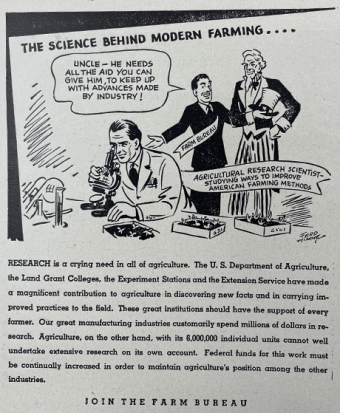
The key transformation in American science during the Cold War was a huge influx of federal money. The federal government, including the armed services, funded science on a scale that was absolutely unprecedented. This began during World War II, when federal investment in science went up by a factor of 10 compared to what it had been previously. The fields that were most affected at that point were engineering and physics. The atomic bomb is the most famous example of this, but there were others as well — the government also spent significant sums of money and employed a long list of physicists and engineers whose job it was to improve radar technology, for example. Funding dropped to some extent when the war ended, but grew substantially again in the 1950s, after the USSR successfully tested their own atomic bomb (1949) and the outbreak of the Korean War (1950) raised fears that the U.S. military technology would soon have to compete with that of the Soviets.
Increased government funding brought other changes. The Cold War transformation of science was organizational and philosophical as well as financial. By the 1950s and 60s, far more academic scientists had ties to federal research labs, and military research was carried out on the campuses of universities and other private research institutions. For example, the Department of Defense funded classified research into advanced mapping technology at Ohio State University, where key elements of American satellite intelligence technology were developed. All over the United States, scientists found themselves with financial and bureaucratic ties to a massive defense-related research structure that had a way of shaping their questions and directing their research in ways that were sometimes all too obvious — and sometimes dangerously difficult to discern.
In other words, science in the United States was integrated into the Cold War security state. This didn’t happen in the same way or to the same extent in all disciplines, and the relationship between scientists, scientific institutions and the government was complex. Neither scientists nor universities were puppets of the state. Nevertheless, a transformation had taken place. Scientists were like swimmers in a river with a noticeable, but not overwhelming current — they could swim against it, but they could not ignore it, and it had a tendency to draw everyone in the water in the same direction.
Photo Credit: Access to back issues of the Suffolk County Farm Bureau News provided by the Long Island Horticultural Research and Extension Center.