
What role did national boundaries and national loyalties play in the scientific research and discovery?
Politics and political differences have always played a role in science. Two competing models about the relationship between politics and science have shaped how scientists and the public have thought about science in its relationship to political boundaries. The first is that science is inherently universal. This means not only that the definition of scientific problems and the standards for resolving them are independent of the scientist’s local context or personal situation —in this sense, the universalism of science is related to the idea of objectivity — but also that scientists are part of a community that transcends national boundaries. This “republic of science” was and remains an ideal, not a real description of how science works, but it is a powerful ideal.
The second model is the idea of scientific discoveries as the cultural or technological achievement of individual countries. The competition might be intense but ultimately friendly, a little like the Olympic games, or — as in the case of the Cold War — the survival of humans as a species might be at stake.
These two models could operate simultaneously in the same time and place, with scientists, citizens and politicians emphasizing one or the other depending on the context. They could also be in direct tension with one another. Cold War-era scientists complaining about restrictions on their freedom to exchange research information with colleagues were arguing for the universal “republic of science” idea, while the politicians who wanted tight controls to protect atomic secrets from the enemy assumed a model of competition.
Conflicts over to what extent science was or should be limited by national boundaries brought up another question that played a determining role in the lives of many twentieth-century scientists. What did individual researchers owe their countries? What, if anything, did their countries owe them? Should a scientist work on a project out of loyalty to his or her nation, knowing that the consequences for people elsewhere in the world could be dire? What about scientists working on research that had humanitarian goals but which was still enmeshed in the political concerns of a specific country, like the technologies of the Green Revolution?
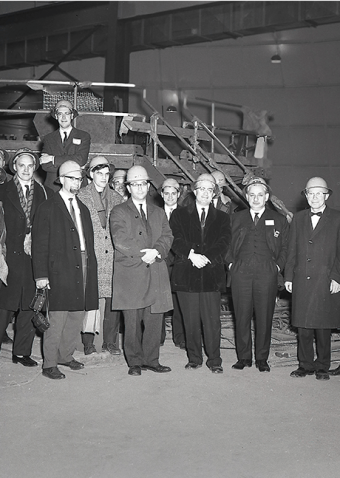
Photo Credit: Image courtesy of Brookhaven National Laboratory.