
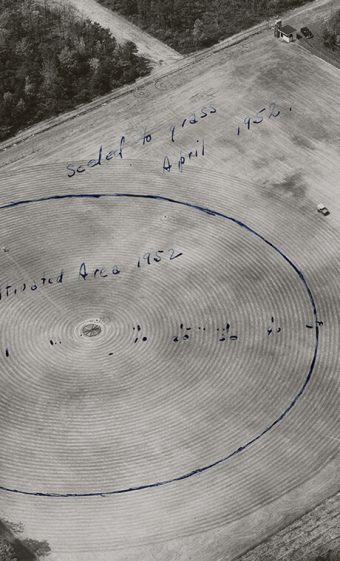
One of the most important experiments at Brookhaven in the 1950s was the “gamma field.” This unusual experiment was described by one newspaper in 1949 as a “mammoth, mystical cornfield,” which suggests both the scale of the project and the way Americans felt about radiation in the years after WWII — there was something slightly awe inspiring and magical about it. The gamma field fell into the category of life science research at Brookhaven that had to do with exploring the effects of radiation exposure on organisms, in this case plants. The experiment consisted of a radiation source, a sample of cobalt-60, placed in the center of a 5-acre field; both the strength of the radiation source and the size of the field were increased in subsequent years. In the first few years of the experiment, plants were planted in rings around the radiation source. The amount of radiation that each ring received depended on the distance from the center, thus allowing researchers to see the effects of varying doses. The radiation source could be lowered via a cable and pulley system into a lead container in the center of the field. This meant that researchers could control the amount of radiation exposure the field received — and they could shut the radiation off, so to speak, so that researchers could safely enter the field to work. This mechanism was the source of a great story that Brookhaven employees often told visitors and journalists. One day, the mechanism jammed and the cobalt could no longer be lowered back into the protective pit. The radiation was intense enough that no one could get close enough to fix the mechanism by hand. Fortunately, Edward Nicholson, who had been the foreman of the lab’s machine shop, was a “crack marksman” and “volunteered to shoot the cable in two. The risk was that if his bullet missed and bent the pipe, it would jam the cobalt permanently. The alternative then would have been to build a thick concrete shield and some how move it through the field to the source. Doctors ordered Nicholson to stay at least 100 feet from the cobalt-60 and gave him no more than one minute to do the job. He darted into the garden and dropped to one knee. The first shot missed. But the second bullet parted the cable and the cobalt-60 dropped neatly into the ground. Nicholson suffered no ill effects.”
An important change was made to the experimental set up in the mid-1950s. In addition to observing the effects of varying doses of radiation on different plants, the researchers using the gamma field hoped to use radiation to induce genetic mutations. They had two goals. First, they wanted to better understand the basic genetic functions of plants. Second, they predicted that the process would generate mutations that could potentially be very useful for agriculture. What was the best way to induce interesting and/or useful mutations? The initial setup of the experiment resulted in the plants being irradiated 24/7 (or nearly so) as they grew. But trial and error, including an incident in 1952 during which the radiation source was stuck in the ground for a few weeks due to a problem with the mechanism, led them to conclude that there was a very specific window for optimal irradiation. This could vary from species to species, but in general a short targeted irradiation period produced better results than longer exposures. W. Ralph Singleton, a Brookhaven researcher who studied maize, determined that for inducing mutations in corn plants, it was best to irradiate the corn “about 1 week prior to pollen shedding, but definitely after meiosis.” Meiosis is the type of cell division that sexually reproducing organisms use to produce gametes — in the case of corn, we’re talking about the pollen. Singleton and his colleagues had found that if plants were irradiated during meiosis, the plant produced little to no functional pollen. In this case, even if the radiation caused significant mutations, “a dead pollen grain is of no use in plant breeding!”
Photo Credit: W. Ralph Singleton Collection, Small Special Collections Library, University of Virginia.