

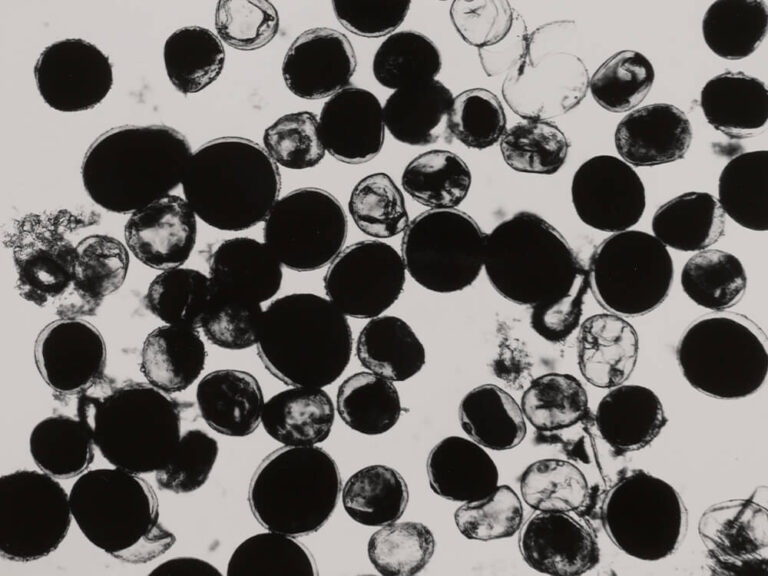
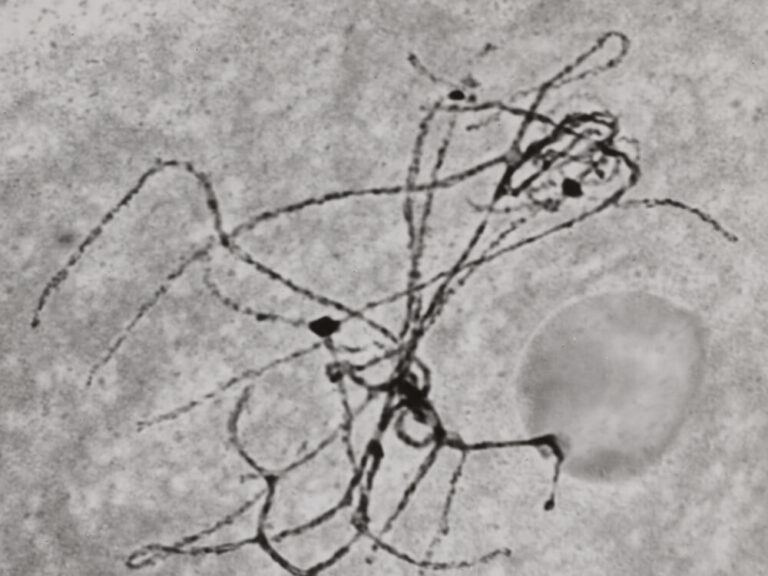
“The dark strands in this photo are the 10 chromosomes in a single cell of a tassel, the male flower of the corn plant. Some 200 to 300 genes, the units which transmit heredity characteristics, are strung like beads along the 10 chromosomes. The blurred oval in this view through a microscope is the nucleolus, or ‘organizer’ of chromosomes in a cell.Source: University of Virginia Special Collections. Used with permission.The photograph is part of a study at Brookhaven National Laboratory, Upton, N.Y., of mutations, or changes, caused in corn heredity by exposure of plants to x-rays. The black specks on the chromosomes are gene sites, which may be affected by radiation. Frequently radiation causes breaks in chromosomes. Recombinations results in a mutant plant which differs from normal, producing changes in plant height, ear size, plant color, and so on. In this case a large dose (2000 roentgens) of radiation caused no breaks in the chromosomes. However, radiation did change a gene site, and the plant mutated to a condition called glossy, in which the plant leaves have a glossy or waxy appearance.
Corn is frequently used in genetics studies because its chromosomes are large enough to be observed easily under a microscope, and because a great deal of information has been gathered about corn genes. As a result, corn breeders have made considerable progress in improving plant strains, and geneticists have assisted in broadening the understanding of mechanisms of heredity.”