
How do plant scientists know what they know about the organisms that they study? How do they formulate their questions, and how do they turn these questions into experiments and interpret the results?
The models that biologists use are in many ways unique. Like their colleagues in other disciplines, biologists do mathematical modeling — indeed, this can be a key component of their research.
In the following interview except, Professor Doreen Ware (CSHL and USA) discusses the models used in her research. The Ware lab uses mathematical modeling to optimize the genome of a given plant for a specific environment. What optimal means in this context depends on what the plant is for — do we want it to be tall? To flower early? To produce larger fruit, more seeds, fewer seeds? In an agricultural context, this is determined by the grower. Using the sequence data from multiple plants growing in a specific environment, Professor Ware and her colleagues use machine learning to find the optimal genome that allows the plant to produce the desired characteristics in the specified environment. One of the exciting things about mathematical approaches like this is that they target the entire genome at once. Before, if you wanted to know which strains of a plant to cross in order to get your desired result, you had to cross them based on genetic markers that you knew about. With the type of modeling used by Professor Ware and her team, you don’t need to depend on markers you know about — you don’t need to know what every gene in the sequence you’re using does in order to predict which future crosses will do well.
Interview with Professor Doreen Ware (CSHL and USDA)
Interview conducted 26 July, 2022, in the Rare Books room in the Carnegie Library at CSHL.
Interviewers: Mila Pollock and Antoinette Sutto
In genomic selection, what you’re really doing is using a machine learning approach. You’re using all of the information in the genome, even if we don’t know what [all of the specific genetic] markers represent. Before, we were focused on markers where we knew what they represented. We knew that this marker was good for disease resistance, this marker would give us a color trait, this marker here might give us something on plant height or this marker here might make it flower earlier, or it may give us more seeds, more grain on the plant.
With the move to genomic selection, we’re now able to optimize for an environment. You’re able to grow populations in an environment. You’re able to pick the best individuals from that environment. Then using genomic selection, you’re able to monitor the genotypes and make a prediction.
But biologists work with living systems. In addition to mathematical models, their models include living organisms — but how can an organism be a model in the same way as, say, a mathematical description or a physical model made of metal or plastic? Unlike a set of equations or a depiction of the chemical bonds of the double helix animated on a screen, living creatures, as science historian Evelyn Fox Keller explains, “are exemplars or natural models — not artificially constructed but selected from nature’s very own workshop.”
This has a number of consequences for biological research. One of these is that there’s less of a distinction between the models and the systems being studied — you might use some specific species of plant, for example, as a model to figure out the genetic pathways that control flower formation in a broader category of plants, or plants in general. Both the model and the target of the investigation are plants. This related to a second consequence, which is that since they are natural objects, biological models can be unpredictable. Even the simplest model organisms can still offer surprises. This is good in a sense, because surprises can suggest new questions and new directions for research, but it can also create challenges: sometimes a biological system reacts in a surprising way and you can’t do the work that you originally intended to do. In fact, researchers have taken steps to make some of the most common model organisms a little less ‘natural.’ These species have been genetically standardized to make them easier to work with in a laboratory environment and so that different groups working all over the world on a given organism can easily compare their results. Such organisms are used to model and explore a wide range of biological functions.
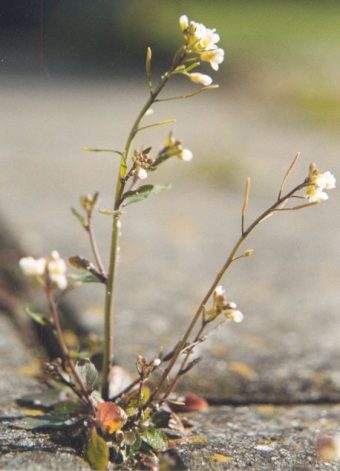
Photo Credit: Brona at en.wikipedia. User: Roepers at nl.wikipedia, CC BY-SA 3.0 , via Wikimedia Commons