
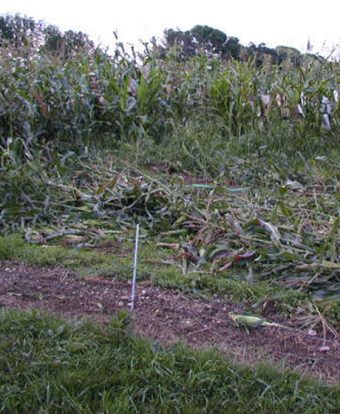
In July of 2000, a cornfield at CSHL’s Uplands Farm facility was vandalized. According to the New York Times, “graffiti denouncing genetic engineering were found scrawled near the trampled rows of corn.” The local officials who investigated the vandalism connected it to a nationwide wave of attacks on experimental crops and research institutions carried out by activists opposed to genetic research. The year before, the Earth Liberation Front had claimed responsibility for a fire at Michigan State University in Lansing, MI, citing work being done there on genetically altered crops.

The vandalism incident at Uplands Farm reveals a lot about the debate about genetically modified crops (sometimes referred to as GM, or GMO for ‘genetically modified organism’). In many ways, the debate about GMOs that has taken shape over the past several decades resembles the debate about recombinant DNA back in the 1970s. There was and is a conversation about safety, with the vast majority of scientists and agricultural producers concluding that GMO crops pose no health or safety hazard. Alongside this, there is a discussion that turns on the concept of interfering with nature and/or the “essences” of living things and raises concerns about unintended and unpredictable consequences for both people and the environment. These discussions are conducted using different terms and based on different assumptions, which meant that in the case of GMOs, just like recombinant DNA, the resulting debate is difficult to resolve.

And the complexity of the debate is not just a matter of differing sets of priorities or assumptions, either. The political and economic context in which GMOs are introduced makes a difference in how people see them. In France, for example, the fear of being imposed on by the United States fed into the opposition to GMOs in the 1990s. In addition, the bovine spongiform encephalopathy (mad cow disease) crisis in Europe had stoked fears there relating to food safety and the relationship between agriculture and industry. In France, unlike in the United States, agricultural producers tended to oppose GM crops, while they were adopted relatively quickly by American agribusinesses. This has meant that even though the level of distrust of GMOs among Americans is not significantly lower than that among French people, GM crops are commonplace in the United States. In other words, the debate about genetically modified plants being used in human food or animal feed is never just about the technology itself — there is always a political, economic and cultural context and this context can make a huge difference in the extent to which GMOs are adopted or accepted.

Part of the cultural context for the debate over GMOs in both United States and Europe is the concept of ‘nature.’ What is nature/natural? In contrast to a term like ‘organic,’ for example, ‘natural’ doesn’t have a precise regulatory or technical meaning. (The USDA has strict regulations as to what can and cannot be labeled organic, and organic foods cannot contain GMO ingredients.) The FDA hasn’t published a strict definition of the term ‘natural’, although the agency has communicated that foods labeled ‘natural’ should contain “nothing artificial or synthetic (including all color additives regardless of source)” that “would not normally be expected to be in that food.” But this refers only to the food product itself, not how it was produced. The FDA notes that “this policy was not intended to address food production methods, such as the use of pesticides, nor did it explicitly address food processing or manufacturing methods, such as thermal technologies, pasteurization, or irradiation. The FDA also did not consider whether the term ‘natural’ should describe any nutritional or other health benefit.” In addition, because of the way regulations about food additives are written, what would count as ‘natural’ even under this general position statement might not seem so to consumers. According to regulations governing flavors, for example, natural flavors (derived from natural sources) can be accompanied by other ingredients as processing aids that are not ‘natural’ according to the commonly accepted sense of the word — but since they don’t contribute to the flavor itself, they are allowed.
For meat, poultry and eggs, the rules on ‘natural’ products are somewhat clearer, since the products themselves contain fewer ingredients. In the early 1980s, USDA published a policy memo outlining the definition of ‘natural’ for these foods: no artificial flavors, colorings, preservatives or other ingredients, and the food cannot be more than “minimally processed,” which includes procedures to make food edible, to preserve it, or to make it safe (e.g. cooking, freezing, drying, etc.). Minimal processing also includes basic physical processes like grinding up meat or separating the whites and yolks of eggs. In the early 2000s, USDA’s Food Safety and Inspection Service noted that based on previous decisions, some additives, such as sugar, sodium lactate (a preservative and flavor enhancer), and some specific natural flavoring agents were acceptable in ‘natural’ foods.
In other words, there is considerable room for confusion and conflict over what is ‘natural’ and what is not. Because the term ‘natural’ is so important in food advertising and yet not well defined by the government agencies that regulate food products in the United States, the court system has been one of the places where the definition of ‘natural’ is argued out. Consumers have sued food companies on many occasion for advertising something as ‘natural’ that wasn’t, at least according to the people suing. High fructose corn syrup has been a frequent subject of this type of litigation.

The issue of what counts as natural, and what agricultural processes are natural versus not natural, is complicated. After the incident at Uplands Farm in 2000, Cold Spring Harbor Laboratory explained to reporters that the field at Uplands Farm wasn’t being used to produce genetically modified corn. The plants there were the result of traditional plant breeding. The New York Times article covering the incident used the word “natural” in its summary of what CSHL had told the press, i.e. that this corn had been created with “natural plant breeding.” It’s worth stopping to consider what ‘natural’ means in the context of genetic research (or even in the context of a domesticated plant like maize). In the case of plants like corn, which has been modified by humans through the process of domestication and then modified differently, with different goals, through the process of scientific research (recall the ‘standardization’ of experimental organisms, e.g. Arabidopsis, which does not require advanced genetic technology to achieve), it’s not clear what ‘natural’ means. Even if neither of these modifications involved cutting and pasting its DNA, e.g. with CRISPR or via the older recombinant DNA methods, the plant has still been heavily modified by human activity.

It’s worth asking why certain modifications to food crops are considered ‘unnatural’ and dangerous, while others are not. Take triticale, for example, a grain found in many natural foods stores. Triticale is a hybrid of rye and durum wheat, two separate species that do not naturally reproduce with one another. When crossed, the resulting hybrid is sterile. In the 1930s, A. F. Blakeslee of Cold Spring Harbor discovered that colchicine could multiply the number of sets of chromosomes that plants have. This technique of inducing polyploidy in plants can be used to make otherwise infertile hybrids fertile, and in the 1950s the colchicine technique was applied to triticale by researchers in Iowa, creating a valuable new agricultural plant. Multiplying the number of an organism’s chromosomes is a fairly drastic genetic intervention, but triticale has not been a focus of concern among people concerned about the dangers of GM foods. Indeed, people around the world have been eating it for decades now with no ill effects.

Corn offers another good example. There are varieties of corn that are resistant to specific pesticides. Some of these are the result of the type of genetic manipulation that those concerned about GM crops oppose — i.e. they have been modified with the molecular techniques that have been developed since the 1970s. But others aren’t. Scientists have known for decades how to grow plants from tissue cultures, i.e parts of the roots, stems, etc. of other plants. These plants are genetically identical to the parent plant, but this procedure often results in genetic mutations. As we’ve seen, plant scientists have historically put a lot of effort into producing mutations in plants, in order to do basic genetics research and also to find plants with useful new characteristics. Chemical mutagens or radiation can be applied to plants grown from cultured tissues in order to encourage mutations, but this isn’t necessary. In general, the mutations that arise through this method of producing new plants are called somaclonal variation. As is the case with genetic mutations in general, many will be harmful, some will make no difference, and a few will be useful. Since the 1990s, farmers in the US have been growing and selling corn that is resistant to pesticides as a result of somaclonal variation. These plants do not have to be (and aren’t) labeled as GM, because plant breeding using somaclonal mutation is considered a ‘conventional’ plant breeding process.
Where should we draw the line between acceptable and non-acceptable modifications of plants? Is it the tools that make the difference, even though some of the same results, as in the case of pesticide-resistant corn, can be achieved by means considered conventional? Is it the human intervention in an organism’s genome — in which case triticale, for example, would be literally off the table?
CSHL Professor Zach Lippman’s work demonstrates how complex this issue is.
Professor Lippman and his group are investigating the genes that regulate how plants grow, flower and produce fruit. When a plant is domesticated, there is a specific set of parameters that are typically altered — when the plant flowers, for example, whether the plant disperses its seeds, how big the fruit is, and the size and the growth pattern of the plant as a whole. Modern agricultural science builds on this by fine-tuning specific traits to better fit with how the plant is currently grown and harvested. But there are some aspects of how plants grow and produce what we want — typically seeds or fruits — that are difficult to fine tune. For example, we know how to change plants to cause them to produce more fruit. But typically this comes with a downside: if no other changes are made other than causing the plant to produce more fruit, the fruit isn’t as sweet. This is because the plant is producing the same amount of sugar, but the sugar is being distributed among more fruits.
As Professor Lippman notes, the line that is drawn between GMO and non-GMO for food products or crops — the distinction that many people use when they consider purchasing a food product — is a policy decision rather than a scientific distinction. In the United States, the Food and Drug Administration (FDA), the Environmental Protection Agency (EPA) and The U.S. Department of Agriculture (USDA) are responsible for regulating GMOs.

It is important to consider not only what counts as a GMO, but how GMOs are used and how they are regulated. Many reasonable objections to GM crops are political or regulatory and have nothing to do with the science itself or with how we define nature or natural. That is, they are based on the power relationships that GM crops reflect or create between people or countries. For example, GM crops are associated with monoculture, which has been shown to have negative effects on the environment. In addition, growing one single variety of, say, wheat or tomatoes means that producers are more vulnerable to new pests or changing environmental conditions — variety provides a defense in this case. But this is true of monoculture in general, whether the crop that is grown is GM or not. The problem is how we have set up our agricultural system and the types of farming that we’ve decided to encourage. The issue of dependence also plays a role. In the 1930s and 1940s, as we’ve seen, the development of hybrid corn meant that farmers could no longer save their seed from one year to the next and instead had to buy it from seed companies. The evidence suggests that back then, farmers weighed the increased yields of hybrid corn against the dependency on seed companies and decided that the trade-off was worth it, although once hybrid varieties became standard, it’s worth asking how much choice they had, and what would have been the likely fate of a farmer who decided to stick with conventional field-pollinated varieties. This same objection, that GM crops make farmers dependent on seed companies, has been raised today, bringing with it the same questions — is the trade-off worth it for the farmer? Do farmers around the world have a meaningful choice about whether to adopt GM crops? As consumers, if our finances are limited or relatively few options are available in the grocery store, how much choice do we have in whether to buy GM food or not, regardless of what we think of it scientifically or ethically?
Approaching GM foods through the history of plant science over the past hundred years helps put this technology in perspective. Scientists have been using the concepts and tools of genetic science to modify crop plants since the early 1900s, when George Shull and Donald Jones developed hybrid corn, crossing inbred lines to create healthy, high-yielding plants — and the science behind hybrid vigor or heterosis, as this is called, is still not fully worked out. Starting in the 1930s, even before it was known that DNA is the carrier of genetic information, geneticists began to change plants’ genetic inheritance, using chemical mutagens like colchicine to multiply their chromosomes and produce variations and combinations that nature itself had not. In addition to chemical mutagens, scientists have also used radiation to induce genetic changes in plants. With the development of recombinant DNA technology in the 1970s, the changes scientists made could be more targeted. In recent decades, improvements in computing and data storage, plus the development of fast, cost-effective sequencing technology and other tools like CRISPR-Cas9 have made it possible to edit individual genes, or determine the optimum genome for a particular plant in a specific environment. We have been genetically modifying our food for a very long time. The decision facing us now is, which types of modifications do we want?