From Idea to Application

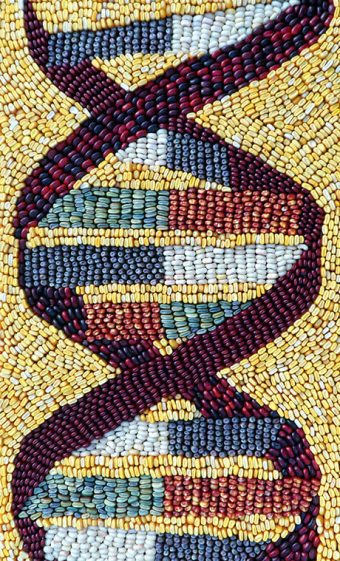
Maize mosaic depicting DNA. Most kernels were grown in a Cornell research field in the summer of 2012, and they represent some of the natural color variation of maize kernels. The color code is: Green = Guanine (G) Orange = Cytosine (C) Blue = Thymine (T) White = Adenine (A).

Going from a scientific discovery to a commercial application is often trickier than it seems in retrospect. Shull saw the agricultural application of his discovery immediately, even though he himself didn’t plan to commercialize it. As he said in the 1909 paper in which he described how corn might be bred using his insight, this part of the process was “wholly outside my own field of experimentation.” He was also aware of one or two potential problems. The big one was that the seed for hybrid corn would be expensive to produce. To understand why, think through the process of producing the seed once more. There are two inbred lines of corn, neither which produces many seeds (corn kernels) due to the negative effects of the inbreeding. To produce the seeds that will be planted, and which will grow into the vigorous hybrid, plants from one inbred line are pollinated with pollen from another inbred line. This means that the plants that produce the seeds for the hybrids are themselves still of the sickly inbred variety — they don’t produce many seeds, even if we know that the seeds are different this time and are going to produce healthy plants when they in turn are planted. This was among the reasons that other experts, including the respected geneticist Edward M. East, were skeptical that this discovery could be applied successfully in agriculture. 

Photo Credit: Jason Wallace, CC BY-SA 4.0 , via Wikimedia Commons

Plants need nitrogen to grow, but a significant portion of the nitrogen in fertilizers is not absorbed by the soil or used by the growing plants. Rather, it washes away into waterways, rivers, and the ocean. This in turn has had devastating effects on marine life. In some areas, excessive nitrogen in the oceans has caused algae blooms that kill wildlife, make it dangerous for people to consume fish or shellfish or in some cases even swim in affected waters. This problem isn’t limited to poorer countries. Nitrogen pollution is a serious problem here on Long Island. In our case, the nitrogen comes primarily from septic tanks and cesspools, although nitrogen from agricultural fertilizers also plays a role. Nitrogen pollution in the waters around Long Island has hampered fishing, made it dangerous to eat seafood from some areas, and caused environmental changes that make coastal areas more prone to flooding.