
The term ‘model organism’ is actually fairly recent. It came into common use in published scientific literature only within the last fifty years or so, and the popularity of the concept was tied to the development and expansion of molecular biology. The term is closely associated with the work on the Human Genome Project in the 1990s, when biomedical researchers suggested a standard set of model organisms to be used in projects related to mapping and sequencing the human genome. In other words, one of the key characteristics of model organisms is that they can be used to model genetic and developmental processes in a wide range of other organisms, including humans.
But even though the term is recent, the idea of using a single organism to understand biological structures and processes relevant for many organisms goes back much further than the rise of molecular biology. Even before biologists knew the structure of DNA, and before they had the tools to investigate biological processes on a molecular level, they were using specific experimental organisms to understand systems common to a wide variety of other living things.
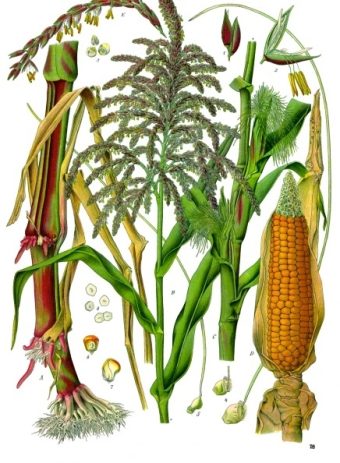
This is where corn comes into the story. Corn (a.k.a. maize, Zea mays) has played a double role in the history of plant genetics. Since the nineteenth century, it has been used as an experimental plant by scientists exploring the mechanisms of heredity. Gregor Mendel is famous for his experiments on pea plants (Pisum sativum), through which he discovered patterns of genetic inheritance that latter became the basis for modern genetics. It’s less well known that Mendel later worked with other plants, including maize, trying to confirm in them what he had observed in peas. Although certain then-unknown characteristics of maize genetics made this harder than he was aware of at that point, maize specialist M. M. Rhoades notes that Mendel “was the first to demonstrate experimentally that the principles discovered in Pisum also held for Zea.” Two of the three scientists that rediscovered Mendel’s work in 1900, Hugo de Vries and Carl Correns, had been working with maize (as well as other plants). Once they understood some more complicated aspects of maize genetics that had previously posed a challenge for researchers in heredity, de Vries and Correns realized “that maize showed the same pattern of inheritance as that found in Pisum by Mendel…Correns and de Vries were among the pioneer maize geneticists. Not only had they demonstrated Mendelian segregation in maize but Correns had unknowingly found what could be considered the first example of linkage.” (Linkage refers to how close together on a single chromosome two or more genes are. Genes that are near one another on the same chromosome tend to be inherited together.)
But even if there had not been this connection between maize and the (re)discovery of the fundamentals of heredity, maize would still have been an important experimental plant for genetics. There were many reasons for this. Maize has a lot of genetic variability, for example, offering researchers many different genes to use in research and breeding programs. On the plant itself, the male and female flowers are physically separated, which made things like inbreeding and hybridization easier. But researchers don’t choose experimental organisms solely as a result of sober theoretical consideration of their advantages and disadvantages for the proposed research. Other factors come into play as well, including what experimental organisms other scientists use and have used, what the individual researcher is familiar with, and what types of organism are easily available.
The choice of experimental organisms is also one of the points at which scientists engaged in basic research cross paths with professional breeders. Plant and animal breeders of the nineteenth and twentieth centuries were intensely interested in the mechanisms of heredity because this would allow them to improve existing species and varieties as well as potentially develop new ones. Researchers in the basic science of heredity knew that the economic potential of their work was significant. They were also well aware of the service to society they could render through assisting in the development, for example, of cereal plants that offered an increased yield or were better able to resist pests.
The rediscovery of Mendel’s laws spurred increased scientific interest in maize. Work with maize was key to convincing researchers in the first decades of the twentieth century that Mendelian inheritance was a general pattern and not confined to just a few simple traits. Through the early 1930s, maize experienced a heyday as an experimental organism as geneticists located important mutations and mapped linkage groups. Starting in the 1920s, Drosophila siphoned off a lot of the interest previously devoted to maize, but a significant number of geneticists continued to work with this plant. Indeed, some famous discoveries in genetics were made using maize, such as Barbara McClintock’s discovery of transposable elements (transposons, or “jumping genes”) in the middle of the twentieth-century. Alexander Brink was working with maize when he discovered paramutation, which is an interaction between two alleles at a specific position on the chromosome through which one allele creates a heritable change in another, through changes in DNA methylation patterns or histone modification. The change is thus epigenetic rather than genetic — the sequence of the affected allele isn’t altered. An important concept in genetics, paramutation is involved in some of our theories of hybrid vigor.
Familiarity and community also played a role in sustaining maize’s importance as a research organism for geneticists. Many research organisms, maize included, are associated with a multi-generational community of researchers. The dynamics of such a community can vary — the scientists who became interested in Arabidopsis thaliana in the 1970s and 80s, for example, consciously went about creating a network of researchers committed to sharing data and working collaboratively, in contrast to what some of them had experienced in other scientific communities.
Photo Credit: Franz Eugen Köhler, Köhler’s Medizinal-Pflanzen, Public domain, via Wikimedia Commons.