
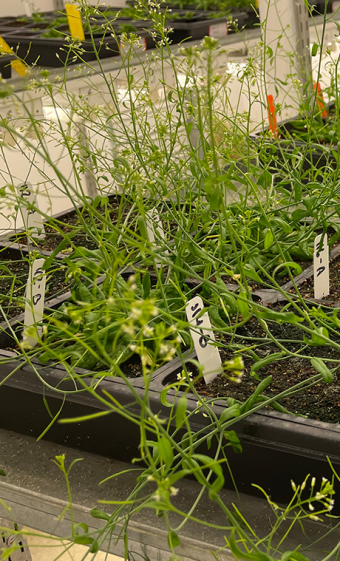
The surge in work on and with Arabidopsis began in the 1980s. But even before that, some scientists had taken an interest in this little plant. Before World War II, German botanist Friedrich Laibach had noted that the species offered a great deal of natural variation, which he thought might be useful for the study of classical plant genetics and development. During the 1950s and 1960s, a few other European researchers continued to develop Laibach’s ideas. In the United States, the key figure in Arabidopsis was George Rédei, “a Hungarian World War II exile” who
“brought [Arabidopsis] with him from Europe. He argued that it was a wonderful model system because it had a very short generation time. It produced a lot of seeds per cross. It was a little small and finicky to deal with and didn’t have classical agronomic traits, but if you thought about it like a botanist, it had all the things that you needed. Then in the 1980s, it was taken on by some Drosophila geneticists who wanted to become plant biologists and some yeast geneticists who wanted to become plant biologists and they were looking for a simple model system and so they adopted this one from George Rédei.”
Professor Rob Martienssen (CSHL), interview with CSHL Library and Archives, 10 May 2022
The gap between the initial interest in Arabidopsis before World War II and its flowering (so to speak) in the 1980s is worth looking at more closely. Why were relatively few researchers in the post-war period interested in Arabidopsis, in comparison to the wave of interest that began around 1980? There were two reasons. The first had to do with funding and institutional support. In the decades after World War II, there was an enormous amount of funding available for basic genetics research — but it was funding for research in animal models. Historian of science Sabina Leonelli notes that the money spent on plant research during this period was directed toward “applied research,” particularly “breeding techniques…on agriculturally significant organisms.” The push and pull of funding and the research interests of the biological sciences community continues to shape research on Arabidopsis. Since scientists can do more in other plants now than they could a few decades ago, funding for work specifically on Arabidopsis has decreased in recent years.
The second reason was related to specific biological properties of Arabidopsis itself. Classical geneticists had been interested in Arabidopsis because of its natural genetic variability. In the post-war decades, however, plant science emphasized induced mutations, and Arabidopsis resisted all attempts to mutate it. It was simply not amenable to the typical techniques for inducing mutations in plants.
What led to the turning point around 1980? According to scientists working in this area, the state of the field of animal genetics had a lot to do with it. Geneticists working on Drosophila faced punishing competition and a research culture that discouraged striking out in new directions. Moving from animal genetics to plants offered an opportunity to tackle basic genetic questions in a less cutthroat environment that offered an escape from ways of thinking structured around the arguments and assumptions of older biologists as well as the chance to develop a different, more collaborative research culture drawing on the methods and theoretical contributions of molecular biology. In addition, Arabidopsis came in a sense ‘prepackaged’ for this project, since there was already a significant amount of well-organized genetic data available. In other words, the adoption of Arabidopsis as a model organism in plant biology around 1980 was related to qualities of the plant itself, but these qualities weren’t the only factor — it also took a shift in the research culture and interests of geneticists.
What have researchers done with Arabidopsis in the past forty years? First, they have created a standardized variety for research, a process which has fairly strict requirements. As science historian Sabrina Leonelli has described it, this involves “issuing strict guidelines concerning the conditions in which plants should be sown, germinated grown, and harvested (temperature, humidity, type of soil and pesticides, etc.).” Emphasis is placed on uniformity, and the plants must be “easily distinguished on the basis of standard morphological parameters, such as the width and smoothness of the leaves, the shape of the flowers and the length of the stem; and to bear the material features most compatible” with the research they will be used in. The resulting plant is different from the ones that grow wild.
Once a research plant has been standardized, a lot of work has to be done to maintain this standard version. This is done primarily through the establishment of stock centers, which produce, store and distribute standardized varieties of the plant. (There are also stock centers for research animals; in the case of plants, the distributed material is typically seeds or DNA samples.) For Arabidopsis, sample collections based on the work of Laibach and Rédei existed in the 1960s and 1970s, but it was in the 1980s and 1990s that large, highly standardized collections were developed in both the US and Europe for the use of a wide community of researchers. One reason for this was that a solution had been found to the problem of inducing mutations in this plant. In the mid-1980s, a technique was discovered that allowed scientists to create mutant strains of Arabidopsis via insertional mutagenesis, or the insertion of new sections of DNA. This not only brought increasing numbers of biologists into the Arabidopsis community, but also created a need for highly sophisticated stock facilities capable of organizing and storing all the new mutant lines.
Arabidopsis has also had its genome sequenced. Begun in 1996, the Arabidopsis genome sequencing project was completed in 2000. It was carried out by the Arabidopsis Genome Initiative, which published a paper in Nature detailing their findings. More information about the Arabidopsis genome (and Arabidopsis in general) can be found via The Arabidopsis Information Resource (TAIR).
The international collaboration to sequence Arabidopsis began at a meeting at the Banbury Center at Cold Spring Harbor. Plant scientist Rob Martienssen tells the story:
“The Drosophila genome project was already underway, and the yeast genome project. Some of those people who had worked in those organisms came along with the plant group here, and we had a long discussion about how it should be done, how much it should cost, whether it should be done at all. Some people said it shouldn’t [laughs] because it was a waste of money [laughs]…Anyway, the genome project of course turned out to be the key that unlocked the biology of Arabidopsis and allowed a lot of functional genetics resources as well as understanding the epigenome and many other things. Arabidopsis turned out to be an incredibly good move.”
Professor Martienssen mentioned that Arabidopsis is useful for understanding the epigenome. What is the epigenome? There is a distinction between genetics, the study of genes, i.e. specific DNA sequences in the genome, and epigenetics, which is the study of heritable phenotypic changes that do not involve changes to an organism’s DNA sequence. How does that work? It sounds a little like magic, but it’s actually chemistry. One important mechanism for epigenetic change is DNA methylation. The molecular structure of the DNA double helix is such that other molecules can bind to it under specific circumstances. In methylation, the molecule in question is a methyl group — one carbon atom bound to three hydrogen atoms. When a methyl group binds to DNA, it can cause changes in the activity and expression of the gene it is attached to. One of the reasons that Arabidopsis was “invaluable in the study of epigenetic inheritance and gene regulation” as the authors of the Nature paper explained in 2000, was because it was “the first methylated eukaryotic genome to be sequenced.” Arabidopsis, in other words, was of enormous value as a model of plant systems — but also of eukaryotic systems more generally.

The Nature paper describing the Arabidopsis genome emphasized this very point. The authors put the achievement in a longer historical context, noting that it was one hundred years since the rediscovery of Mendel’s laws, which were originally discovered using plants. The sequencing of the Arabidopsis genome was a significant achievement in plant science, promising insights into a variety of genetic mechanisms in plants and the establishment of “rapid systematic ways to identify genes for crop improvement.” But its significance went beyond questions specific to plants. A comparison of the Arabidopsis data with that from the genomes of other model organisms whose DNA had also recently been sequenced — Drosophila and C. elegans — offered insights into which genetic features were specific to plants and which were shared among eukaryotes in general.
In the 1860s, when Mendel was doing his work on heredity in peas, the work of botanists, studying and classifying plants, was not assumed to be readily applicable to other living things. Leaping forward to the early 1900s, we can see plants (peas and maize, to take just two) being used in the abstract study of heredity, with conclusions applicable to many other organisms. By 2000, a little plant of no real significance in itself was the focus of an enormous expenditure of time, money and work in order to sequence its genome with the intention of using the resulting data — combined with further work on the plant itself — to explore and model a wide variety of biological systems. Plants have outgrown their original scientific pot and are branching out in all kinds of new directions.
Click below to listen to sequencing expert Professor Dick McCombie of Cold Spring Harbor Lab talk about the beginning of the Arabidopsis sequencing project in the 1990s. Not everyone back then thought the project would be worthwhile…
Professor Dick McCombie talks about the Arabidopsis sequencing project, Clip 1: How it all began
- "McCombie interview clip 1".
Professor Dick McCombie talks about the Arabidopsis sequencing project, Clip 2: Why was the idea controversial?
- "McCombie interview clip 2".
Professor Dick McCombie talks about the Arabidopsis sequencing project, Clip 3: How new sequencing technology changed research
- "McCombie interview clip 3".