
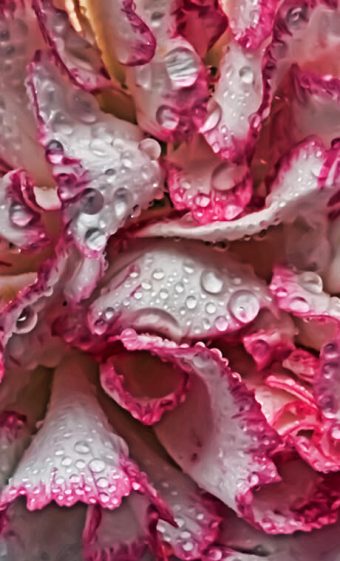
Among the most successful inventions that emerged from the Brookhaven plant irradiation program was the development of a red carnation from a line of white ones. In the early 1950s, the Rural New Yorker described how “a red carnation grew out of a patch of white ones in the gamma field, and, later rooted for propagation, produced more red carnations.” Other reporting clarified that this red carnation had appeared on a plant all of whose other flowers were white. This was a textbook example of the types of mutation researchers had hoped to produce — a clear genetic change which could be perpetuated in later generations of the plant. The point was not that red carnations had not existed before, but rather that scientists were closer to being able to understand and manipulate the mechanisms that governed their color. Nearly all the press reportage that covered the experiments at Brookhaven mentioned the red carnations — it probably seemed like yet another wonder of the atomic age that scientists could aim a beam of “atomic rays” at a plant and change the color of its blossoms.
Brookhaven scientist Ralph Singleton described to Newsday how his colleagues were extending this research further. Not only had they “changed a white carnation to red by radiation,” but they had also “developed a White Sim variety of carnation with no flecks of red.” Brookhaven’s annual reports show biologists there working out the details of these color changes, including the question of whether they were seeing true mutations, in the sense of heritable changes in genes, or whether some other mechanism might be at work. In some cases, the color change was the result of the plant being injured by the radiation, but not fundamentally changed; in other cases, the change was genetic, a “true mutation.” Such variations were of great interest to breeders and sellers of ornamental plants, and scientists elsewhere also contributed to developing these flowers. Soon after the discovery at Brookhaven, researchers at the University of Connecticut had built on this work and produced “three new types of carnation” which were “ready for release to growers for field testing under standard commercial conditions.”