
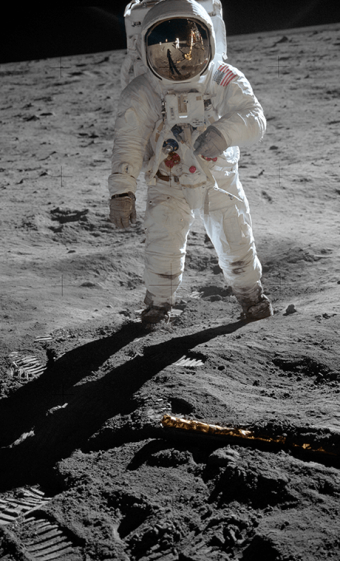
In addition to national security, the United States wanted to show the world that American values and technical knowhow were superior to those of the Soviet Union. This was important because the West wanted to win over those nations that were not yet aligned with either superpower. Americans drew connections between their open, competitive culture and how they did science. They argued that if American science proved to be superior, than so were the things that shaped and supported it — capitalism and democracy. This goal of demonstrating ideological superiority was linked to security goals, but it went beyond that. The Apollo space missions, including the famous Apollo 11 mission that landed American astronauts on the moon in 1969, are a good example of this. That the Americans were the first to successfully land a man on the moon was reassuring in the context of defense because it suggested that the Americans were ahead of the Russians technologically. In the late 1950s and early 1960s, when the Soviets launched the first man-made satellite, Sputnik 1, and then a few years later sent the first human into orbit around the Earth, the Americans had feared that the USSR might soon control the skies. When astronauts Neil Armstrong and Buzz Aldrin set foot on the moon, it was a confirmation that the United States had not lost the Space Race. Broadcast live all over the world, it was also a powerful demonstration of American creativity, scientific skill and engineering prowess — the first human words broadcast from the moon were in English, and the first flag planted there the Stars and Stripes. It was hard to imagine better advertising for Western democracy.
Photo Credit: NASA, via Wikipedia. Public Domain.