
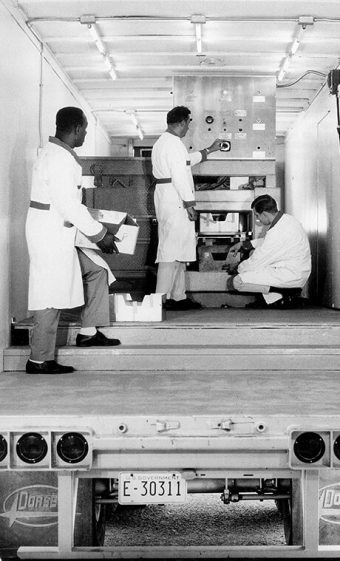
Other than the golden nematode, the other great threat to Long Island’s potato crop was sprouting. Potatoes couldn’t always be sold immediately. When they were stored for long periods of time, they began to sprout, or in some cases, to rot. Could radiation be used as a preservative on food — did it work, and was it safe? The answer to both of these questions was yes, although the expense of the process was initially a barrier to its implementation. The work on food irradiation that was carried out at Brookhaven in the 1950s and 60s provides a snapshot of a developing technology that is still in use today. It also shows how the science at this famous national lab was of immediate practical relevance to people living and working on nearby farms on Long Island. More than this, it offers a window into a very Atomic Age mind set: potentially, any problem might be solved through the application of a sufficient quantity of the right kind of radiation.
In 1952, a local paper reported on the various projects at Brookhaven that involved irradiating plants, explaining that in general, “the work has confirmed that damage in plants is directly related to the amount and rate of exposure to radiation,” and that the scientists suspected that “genetic changes induced by radiations can improve strains of crop and forage plants.” Workers at Brookhaven had also subjected seed potatoes with “eyes” — that is, ones that were ready to sprout — to high levels of radiation to see what would happen. These irradiated seed potatoes were planted, and it was determined that “the yield of mature potatoes fell off in proportion to the amount of radiation exposure.” When scientists dug up the irradiated potatoes that hadn’t sprouted, they discovered something interesting. “Normally, potatoes that fail to sprout will rot; these tubers, heavily exposed to radiation, were still fairly firm even after months underground.” Two years later, Newsday ran an article explaining that “after six years and 30 bushels of spuds,” Brookhaven biologists Arnold H. Sparrow and Eric Christensen “revealed today that they have the answer to dirt farmers’ prayers: they know how to keep potatoes from sprouting, getting soft, or rotting away.” All you needed was “an X-ray machine.” This posed some practical problems — due to the cost, farmers would have to cooperate to afford the technology. The US military had already expressed interest in the process. In this case, the availability of technology played an important role: the military already had x-ray machines “made during World War II that have been sitting around with nothing to do.” A month after the Newsday piece appeared, the Suffolk County Farm Bureau News published a front page article drawing information from a recent publication in Nucleonics Magazine (a popular science magazine about nuclear technology that was published from the late 1940s through the late 1960s) and describing how “Brookhaven lab biologists” were “test[ing] nuclear rays to lengthen spud storage.” The article provided details, including the type of radiation, and noted that the process could not be used on seed potatoes, because it would prevent them from sprouting. A local manufacturer was thinking about building “gamma ray machines for irradiating potatoes.” His plan was to “lease the instruments to farms on a daily rental basis so that the grower can treat his crop as he places the tubers in storage.” We don’t know what became of the mobile potato irradiation apparatus, but irradiation is still used today to prevent potatoes from sprouting.