
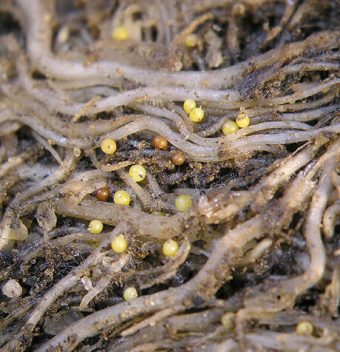
In the 1940s, a terrifying agricultural pest began to plague American potato growers: the golden nematode worm. Nematodes create cysts containing their eggs on the roots of the plants they infest. The damage this does to the roots means that the plants grow poorly and often don’t produce sufficient chlorophyll to meet their energy needs. The tricky part of a golden nematode infestation for farmers is that the infestation begins slowly over a period of several years, and thus it’s often not recognized until it has done considerable damage. In addition to this, nematodes are hard to root out — once a field is infested, it can take decades to fully eradicate them.
This tiny roundworm originated in the Andes in South America and probably reached Europe some time in the 1800s by hitching a ride on imported potatoes. By the mid-twentieth century it had arrived in the United States — and the town of Hicksville, Long Island, has the distinction of being ground zero. According to the USDA,
A farmer in Hicksville, Long Island, NY, was little concerned in 1934 when he noticed a few isolated spots in his potato field where vines were stunted and off color. Within 4 years, however, the spots and multiplied and commercial losses to his potato crop were being sustained…Subsequent examination of the property showed that the entire field was infested and crop losses were as high as 70 percent; in an adjoining field, marked injury was apparent. Available information on the distribution of the pest indicates that all Long Island infestations may have originated from this 40-acre field. The reuse of burlap bags for picking potatoes and the movement of farm machinery by renters were major factors in the local spread of the disease…[The worms] could have been brought [to Long Island] on military equipment being returned to Long Island military camps after World War I. From the extent of the infestation in 1941 and the history of the field, the nematode had probably been present for 20 years before it was identified.
The pest was a nightmare scenario for farmers on Long Island — it was difficult to detect, a challenge to eradicate, and it preyed on what was then one of their most important cash crops: potatoes. In the late 1940s, measures were taken on the state level to prevent the spread of the infestation. Farmers in Nassau County were paid to keep fields out of cultivation, and any farm equipment crossing the Nassau-Suffolk County line was steam cleaned. (Long Island has four counties: Brooklyn (Kings County) and Queens (Queens County) at its western end, which are part of New York City, and then Nassau and Suffolk Counties to the east). Even with financial support from the state, farmers in affected areas were hit hard economically. Despite efforts at containment, the plague soon spread eastward into Suffolk County. The situation was serious enough that in the 1940s and 50s there was a U.S. Nematode Research Laboratory in Hicksville dedicated to the problem.

It must have seemed too good to be true when Brookhaven scientists, in collaboration with researchers at the nematode lab in Hicksville, announced that they had found a potential solution: radiation. As Newsday put it in May of 1955, “atom scientists…revealed plans to mow down the potato’s two deadliest enemies — golden nematode and sprouting — with a double-barreled blast of radiation.” Arnold H. Sparrow of Brookhaven and his colleagues at the U.S. Nematode Research Laboratory reported at a conference “that 20,000 roentgens of radiation could render the nematode sterile.” The FDA considered the idea promising, but wanted more testing before it was implemented. (For comparison, a full-body exposure of 100 roentgens will cause radiation sickness in humans; without treatment, a dose of 400 roentgens will kill anyone exposed at this level within thirty days.) Prior to this, the primary methods for getting control of a golden nematode infestation were crop rotation, since the worms grew on potatoes but not other agricultural plants, and soil fumigation.
Did Arnold Sparrow and his colleagues get a chance to implement their atomic-age solution to the invasion of the golden nematodes? Alas, they did not. Within a few decades, agricultural scientists developed nematode-resistant varieties of potatoes. This in combination with crop rotation and careful inspection and quarantine measures remains the best defense against golden nematodes.
But there is one more episode worth relating in connection to the early Cold War-era nematode infestation. According to a retrospective written by Cornell plant pathology professor William F. Mai and Armand R. Maggenti of the Department of Nematology at UC Davis, the nematode research station in Hicksville was a fairly modest operation, “reminiscent of four garages shoved together.” Various different types of nematodes were the subject of research there, including one that infests garlic and onions (Ditylenchus dipsaci) as well as the golden nematode Globodera rostochiensis, destroyer of potato crops. Both of these worms were “the subject[s] of strict federal quarantine[s].” This research station in Hicksville burned down under somewhat suspicious circumstances. Did someone angry about the effects of the quarantine on their bottom line burn down the research station? Or was someone afraid that the research there —perhaps in conjunction with atomic marvels at Brookhaven — might produce new, possibly even more devastating pests? The documentary evidence is sparse, and the fire may well have been an accident. Ultimately, unless new evidence comes to light, we may never know what happened.