
During the middle decades of the twentieth-century, the 1940s through the 1960s, agricultural scientists worked to develop disease-resistant, higher-yield crops for different regions and climates across the world. The most famous example of this was the work of Norman Borlaug, who — among other significant achievements — developed a variety of short-stemmed wheat designed to be used with the powerful chemical fertilizers developed after WWII. Conventional taller wheat plants collapsed under the weight of the increased amount of grain they produced, but Borlaug’s dwarf wheat did not. Borlaug’s work was key to the so-called ‘Green Revolution,’ which used powerful new fertilizers and specially-bred crops to increase agricultural output across the world and thus feed a rapidly-multiplying global population. The Green Revolution was connected to the Cold War in that in addition to assisting poorer countries, Western scientists and their governments hoped that through providing technological and agricultural aid, they would convince developing nations of the superiority of both western science and the western political and economic system.
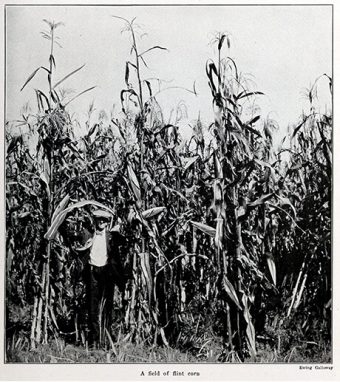
One of the big projects in radiation breeding at Brookhaven National Lab was part of this international scientific and political effort. Corn geneticist W. Ralph Singleton and his colleagues were hard at work developing a variety of short corn that would have the same advantages as Borlaug’s short wheat. Singleton had in fact been working on short corn for years, even before he came to Brookhaven in 1948. Once there, he continued to work on the problem. Singleton achieved significant successes through non-radiation-related breeding methods, specifically “crossing and inbreeding tall and short corn until the gene…determining shortness became predominant,” as the New York Times described the process in 1948. He and his colleagues hoped to speed up the breeding program for this disease-resistant short corn with the aid of radiation-produced genetic mutations. By the early-1950s it seemed that success was within reach. Newsweek reported in 1951 that the radiation program had already provided a number of useful mutations, including of genes affecting “sweetness, size, color, texture of seed, ear length, and plant height. One particularly interesting line” was “a shorter, easier-to-harvest stalk.” The challenge at this point was to combine these new mutations with previous advances in corn breeding. In 1952, the New York Times reported, citing an Atomic Energy Commission report, that scientists at Brookhaven were working on precisely this: they hoped to “to speed the incorporation into hybrid corn of a genetic mutation that will result in a hybrid shorter plant with a higher proportion of grain to stalk.” Ultimately, Singleton and his colleagues did not develop a variety of disease-resistant hybrid short corn. He and postdoc Calvin Konzak published a few papers about their corn radiation work in the mid-1950s, but seem to have let the project go after that. As is so often the case in science, sometimes an idea that seems like a sure thing fails to pan out in the end.