
One of the primary goals of the radiation and plant genetics research program at Brookhaven was to create disease-resistant varieties of important agricultural plants. The scientists engaged in this research thought of it as ‘speeding up evolution.’ Normally, genetic mutations that caused substantial changes in a plant were rare, and mutations useful for plant breeders were rarer still. Plant breeding was seen as a frustratingly slow process. But if mutations could be induced at will with radiation, then this process would go significantly faster. Not all the mutations produced by the radiation would be those that the scientists wanted, but upping the total number substantially raised the likelihood of finding one they wanted within a reasonable period of time.
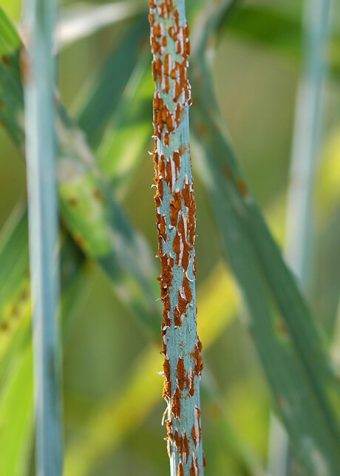
In the early 1950s, scientists at Brookhaven believed that they had induced a mutation in oats that made the plants resistant to stem rust. Oat rust was and is a significant problem for cultivators of oats. It is a fungal disease that considerably reduces the yield and quality of the grain. There are different types of oat rust, including crown rust, which attacks the plant’s leaves, and stem rust, which attacks the stem.
Rust-resistant oats were an exciting achievement, and Brookhaven biologists mentioned it whenever they discussed the successes of the radiation breeding program. In the spring of 1954, for example, Brookhaven radiation biologist W. Ralph Singleton gave a presentation to the research and development subcommittee of the Joint Congressional Committee on Atomic Energy. These hearings were a response to the first ever detonation of a hydrogen bomb (far more powerful than the atomic bombs that the US dropped on Japan in 1945), at Bikini Atoll in the Pacific Ocean. There was widespread concern about this new weapon and fear of the resulting atomic fallout. The Atomic Energy Commission (AEC) claimed that fallout wasn’t dangerous, which was in contrast to concerns of geneticists about the effects of radiation on living things. The broader goal of Singleton’s testimony was to emphasize the positive, peaceful uses of atomic energy. Being able to highlight this “spectacular” discovery, as he described it, served that broader purpose as well as drawing attention to the cutting-edge biology being done at Brookhaven and its applications for agriculture.
The scientist who had developed these disease-resistant oats was postdoc Calvin Konzak. How had he done it? Konzak had used neutron irradiation in his experiment. That is, these oats had not been grown in the gamma field. Rather, Konzak had used one of the other tools that Brookhaven scientists had at their disposal to irradiate plants, a thermal neutron exposure device attached to Brookhaven’s nuclear reactor. In Brookhaven’s Annual Report for 1952, the setup was described as a
10-in. cube at the center of a 5-ft cube of graphite, with appropriate lead, bismuth, boron and steel shielding. It is possible to put specimens into the exposure chamber by means of a maze without disturbing the operation of the pile. The thermal neutron flux is about 1 x 10⁹ n/cm2/sec; the cadmium ratio about 104 and the gamma-ray contamination about 50 r/hr. This is considerably better than other existing thermal columns.
Through exposing oat plants to radiation in this way, Konzak had succeeded in creating a mutation for resistance to rust. Singleton’s discussion of his colleague’s results when he spoke to Congress in 1954 emphasized the speed and cost-effectiveness of the method: “After only one and a half years and at a very small cost, he has a small amount of oat seed tailored to these specifications [i.e. stem rust-resistant and high yield]. This is something which would have taken at least ten years by conventional plant breeding methods, and at considerable expense.” These congressional hearings were open to the public and there was plenty of press coverage. Reporters described, for example, how radiation would accelerate evolution and “atom rays” would create disease-free oats. It was the perfect space-age success story — the power of the atom harnessed not for dangerous weapons, but for improvements in agriculture that could help feed the hungry and demonstrate the power and benevolence of American science.
Unfortunately for Konzak, it turned out that the story was a little more complicated that this. Within a few years, there was evidence that “in earlier studies…a number of the resistant plants resulted from natural crosses with oats from a neighboring field.” The plants were indeed resistant to stem-rust, but the origin of the change lay in naturally occurring crosses with other oats, not the bombardment with neutrons. Did this mean that radiation genetics didn’t work? Not necessarily, as Konzak explained in a 1959 article describing these results (find it in “Follow the Science” below).