
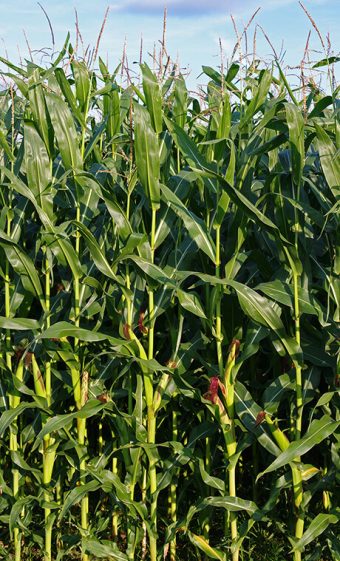
Essentially all of the varieties of corn grown in the United States today are hybrids. The word ‘hybrid’ often conjures up images of industrial agriculture, advanced genetic technology, and crops that have been modified through recombinant DNA techniques or gene editing tools such as CRISPR-cas9. The history of hybrid corn, however, goes back much further than that, back to the early 1900s.
Before we get into the context, it’s important to understand what hybrid corn actually is. What makes it different from other corn? Hybrid corn was developed in the early 1900s. It’s not the result of gene editing or DNA manipulation, since those things were unknown at the time — DNA’s role as the carrier of hereditary material was not discovered until the 1950s. Rather, hybrid corn was the result of a new and creative application of tried and true agricultural techniques.
Getting the hybrid corn seed that the farmer plants requires a series of steps. First, agricultural scientists create two lines of inbred corn. That is, you have one set of corn plants of some specific type, and you pollinate each plant with its own pollen. Corn typically cross-pollinates — the pollen from one plant will fertilize a different plant. But when each plant is pollinated with its own pollen, and you repeat this step multiple times with subsequent generations, you get inbred plants. Inbred plants tend to be small and sickly and do not produce a lot of seed. But when you take two separate inbred strains of corn and cross them — i.e. pollinate set A with the pollen from set B, or the other way around — you often get plants that are very healthy, vigorous and high yielding. These are hybrids. The vigor and high yield of these plants is called ‘hybrid vigor’ or heterosis, and scientists today are still figuring out how it works.
Interview with Professor Robert Martienssen
Interviewer: Antoinette Sutto
AS: So, I just have a general question. My understanding is that we’re not quite sure what the explanation for hybrid vigor is. Where is the scholarship on that right now? What have you guys discovered about epigenetics, and does that do anything to that discussion about how hybrid vigor works in general?
Rob: It’s an old question. I think part of the reason it’s an old question without a firm answer is because it’s probably multiple things that make hybrids more successful. When you look at experiments like George Shull’s, where you are mixing an awful lot of germplasm together, it’s difficult to tease apart what’s really responsible. There is an epigenetic theory of hybrid vigor. I think it does play a role. It’s actually quite well advanced now in maize and is thought to depend on paramutation in part because paramutation has the genetic property of overdominance, where it causes a phenotype that’s essentially different, especially in the next generation, from the parents.
So, there is an epigenetic theory of hybrid vigor.
AS: That was related to what?
Rob: Paramutation. Myself, I think the biggest advances in understanding hybrid vigor have actually come from what’s sometimes called single gene heterosis, where a single gene can be shown to have that property. In other words, alleles of that gene when combined in a hybrid have higher yield than either parent that only has one of those alleles. There are wonderful examples from tomato; Zach Lippman discovered the first of those working with Dani Zamir in Israel a long time ago — not that long ago, 20 years ago. And actually, we have a great example in oil palm as well. The shell gene does the same thing.
Oil palm fruits are a lot like mini coconuts. They have a shell on the inside. The outside looks like an olive or something, it’s a fruit. But on the inside, separating the fruit from the seed, is a shell. It’s maternal tissue. It’s hard. It can be really thick, and when it’s thick it occupies a lot of the fruit and so it reduces oil yield because the shell itself doesn’t make any oil. If you don’t have the shell at all, then you can still get a fruit and a seed just about, but they have all sorts of problems. Often they’re sterile, and so don’t make very much oil either. If you make a hybrid between the two, you get something called a thin shell, and that’s in a Goldilocks sort of way, perfect and makes 30%, 40% more oil than either parent.
Anyway, we did find that gene, and it displays single gene heterosis in exactly the same way that Zach Lippman’s example did in tomato. We think there’s a very interesting theoretical model behind that, which I often attribute to Jim Birchler at the University of Missouri, which is that — and this is absolutely true for the example in oil palm because it does fit this model very well — is that some important regulatory genes encode proteins that have to make multimers, so not just one subunit, but many different ones. If you have a hybrid, that multimer would be composed of two different subunits together, and if you have one parent on its own, it’s only composed of one subunit and not both.
What Jim Birchler argued was that depending on the dosage controlled by those alleles, and this fits the shell model very well, you will get less or more in the hybrid of these multimers that are called heteromultimers. Anyway, it’s a mathematical model, and it works pretty well, and it works on the basis of individual proteins… Now, that doesn’t mean that that mechanism explains all hybrid vigor. This is the point I was making at the beginning, is that hybrid vigor is probably many, many things, all adding up to something that is better. As a geneticist, I love being able to pinpoint a single factor by isolating it from all others and then saying, “Okay, this is what’s responsible for this particular thing.” That’s my understanding of heterosis. There are actually many other theories for heterosis still around.
Important terms:
germplasm: hereditary material
phenotype: an organism’s observable traits and characteristics
epigenetics: the study of stable and heritable phenotypic changes that do not involve changes to the DNA sequence. Often these changes have to do with whether and how much a given gene is expressed. If a gene codes for a protein, for example, an epigenetic change might cause more of this protein to be produced, or less of it — or none at all.
paramutation: an interaction between two alleles at a specific point on the chromosome through which one induces a heritable change in the other. Like so many other things, it was first observed in maize.
overdominance: imagine a gene with a dominant form, A, and a recessive form, a. Each person has two copies of this gene. Some are AA (homozygous for the dominant form), some are aa (homozygous for the recessive form), and some are Aa (heterozygous). Overdominance is when being heterozygous for a gene provides an individual with traits that do not appear in individuals that are homozygous for either the dominant or the recessive versions of the gene.
heterosis: hybrid vigor
multimer: a protein molecule made up of two or more polypeptide chains
The upshot: hybrid vigor is probably caused by many different things, and we’re still teasing apart what those things are and how their effects combine to produce the result that we see.
Photo Credit: (c)2006 Derek Ramsey (Ram-Man), GFDL 1.2 , via Wikimedia Commons